Eight regions · Twelve months · 96 verdicts
Pick your month.
We’ll be blunt.
Rainfall, heat and crowds for every region we work in, and a one-line answer on whether we’d send you there. Fourteen years of trips, not a brochure.
The planner
Where a given
month actually works.
Figures are mean monthly rainfall in millimetres, average daytime high, and how busy the region feels on the ground. The verdict underneath each one is ours — the same thing we’d say on the phone.
Travelling in January
Twelve-bar charts show the shape of the year within each region and are scaled to that region’s own wettest month — the gauges above are on a single scale across all eight, so you can compare them directly.
Four things worth knowing
The rules of thumb
that actually hold.
"Rainy season in Southeast Asia" is not a useful sentence. These four facts do most of the work when we’re deciding where to put a given fortnight.
01 — Thailand
The two coasts are out of phase
The Andaman side is wet May to October; the Gulf side is wet October to December. In September, Phuket gets 340 mm and Samui gets 125 mm. They are ninety minutes apart by road. Almost nobody makes this swap, and it is the single easiest way to save a holiday.
02 — Vietnam
Hội An’s rain is nothing like Hanoi’s
Northern Vietnam is wettest in July and August. Central Vietnam is wettest in October and November — 600 mm in October, when the Thu Bồn river usually puts the old town under water once or twice. A two-week Vietnam trip in October has to be built north to south, or not at all.
03 — Indonesia
Bali and Komodo dry out on a different clock
Bali’s wet season is roughly November to March. Komodo and Flores sit further east and drier — August averages 5 mm — but the wind turns earlier, so crossings get rough from November. April, May and September are the three months where everything east of Java lines up.
04 — Everywhere
Dry season is not the same as good
March in Chiang Mai is dry and unbreathable — field burning puts the air quality into the hazardous band for weeks. July in Bali is perfect and gridlocked. The shoulder weeks either side of the obvious months are usually the answer: late April, late September, mid-November.
Dates we plan around
Things that happen
on one day only.
Some of these are worth building a trip around. Some of them are worth being a hundred kilometres away from. We’ll tell you which is which.
The date moves — late January to mid-February — and for about a week either side, domestic flights and trains are fully booked, family-run restaurants close, and half the guides you’d want are with their own families, which is exactly where they should be.
It is genuinely beautiful in Hanoi and Hội An on the days it’s running. It is a bad week to be trying to move around the country. We either build a trip that sits still through it or we move you out by a fortnight.
For twenty-four hours the whole island stops. No flights in or out — Ngurah Rai airport actually closes. No vehicles, no lights after dark, no leaving your accommodation. Local pecalang wardens enforce it and they are not joking.
The night before is the opposite: the ogoh-ogoh parades, enormous papier-mâché demons carried through every village and then burned. If your dates catch it we put you somewhere with a view and a good kitchen, and you have the strangest quiet day of your life. If they nearly catch it, we shift you.
Three official days, five or six in practice in Chiang Mai, where the moat becomes the ammunition supply for the largest water fight on earth. Nothing dry survives it, including your phone and your plans.
It is a wonderful thing to be in once. It is a terrible thing to be in if you have a flight, a booked boat or small children who don’t want a bucket of iced water in the face. Road accident rates roughly triple. We either put you in the middle of it on purpose or on an island.
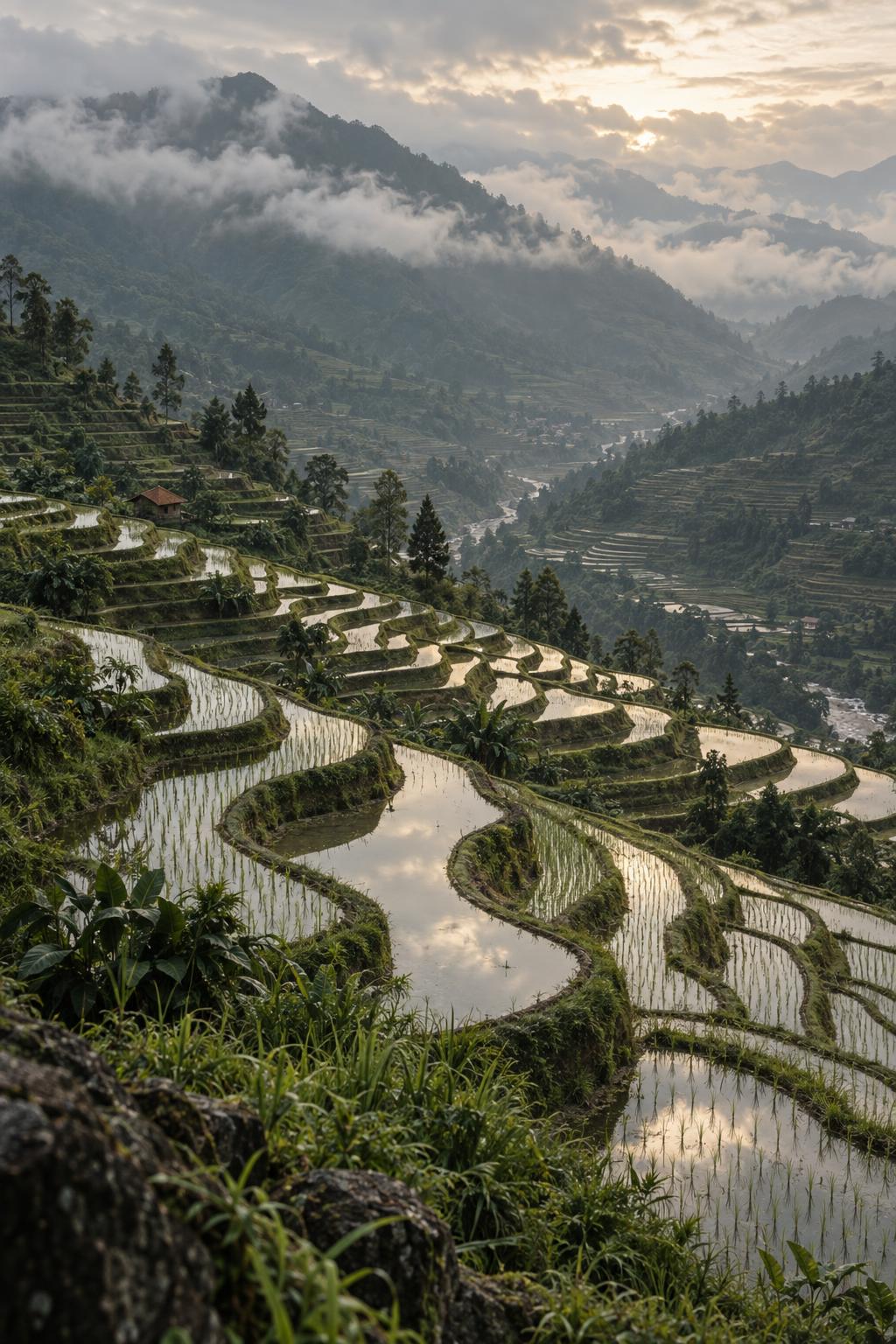
The famous photograph — a whole hillside of water panes reflecting the sky — exists for about six weeks a year, when the terraces are flooded for transplanting and before the seedlings green over. Usually mid-May to late June, but it follows the first proper rains and can slip a fortnight either way.
Come in August and you get green terraces, which are lovely and completely different. Come 10 September to 5 October and you get the gold harvest, which is the other photograph. Come in February and you get mud and fog.
Not a festival — a fact. In a normal year the river comes over the bank onto Bạch Đằng street once or twice between mid-October and late November, knee to waist deep through the old town. Shops move their stock upstairs, boats replace bicycles, and life carries on with impressive calm.
Hà’s family have lived four streets from the river for three generations and she can usually call it three days out. But we don’t sell October in Hội An, because a two-thousand-dollar week shouldn’t rest on a river gauge.
Baskets of flowers and candles floated down the Ping river, and — the same week, a separate Lanna festival — thousands of paper lanterns released into the sky. It falls on the November full moon, so the date moves, and Chiang Mai sells out four or five months ahead.
The mass lantern releases you’ve seen photographed are ticketed events outside the city. The better version is the small neighbourhood one at Wat Phan Tao, which is free, quiet and about four hundred people rather than ten thousand.
Who tells us what the weather is actually doing
Five of the thirty-one people on the ground.
Reads the tide table so we don’t have to. Twenty-two years on the bay; knows which hongs are passable at what water height.
Six people maximum, her own kitchen, southern repertoire. Has cooked for us since 2016 and has never once done a demo class.
Drives the northern loop year-round and tells us three days ahead when the Mã Pí Lèng pass is going to be in cloud or worse.
Bromo and Ijen since 2012. Owns the only jeep with working heating and the judgement to call off a 3am start when the rim is socked in.
Runs our phinisi out of Labuan Bajo. Will move a whole itinerary overnight to put you on the right side of the current at Batu Bolong.
Still not sure?
Send us the weeks.
We’ll send back
the map.
Most people come to us with dates fixed by school terms or a job, and the whole question is what to do with them. That’s the easy half of our work and we’re happy to answer it before you commit to anything.